> ## Documentation Index
> Fetch the complete documentation index at: https://docs.darkpool.fun/llms.txt
> Use this file to discover all available pages before exploring further.
# Self-Sponsorship
> Pure Sui-native sponsored-tx protocol. Our backend signs as gas owner.
The `POST /v1/sponsor` endpoint is DarkPool's gas onramp. It uses Sui's native sponsored-transaction protocol with no Enoki Portal allowlist, no third-party dependency, and the ability to sponsor any package. **Both zkLogin and wallet users** sign trades without holding any SUI.
## Why we shipped it
The user had configured `Allowed Addresses` in the Enoki Portal with the *package IDs* (wrong field; that section gates sender addresses, not Move targets), so every sponsorship attempt 403'd. Asking the user to redo the Portal config was both fragile and a third-party dependency. Self-sponsorship sidesteps it entirely.
Enoki sponsorship stays as **Strategy 1** for zk users. The user paid for the credits and we shouldn't waste them when the Portal is correctly configured.
## Wire protocol
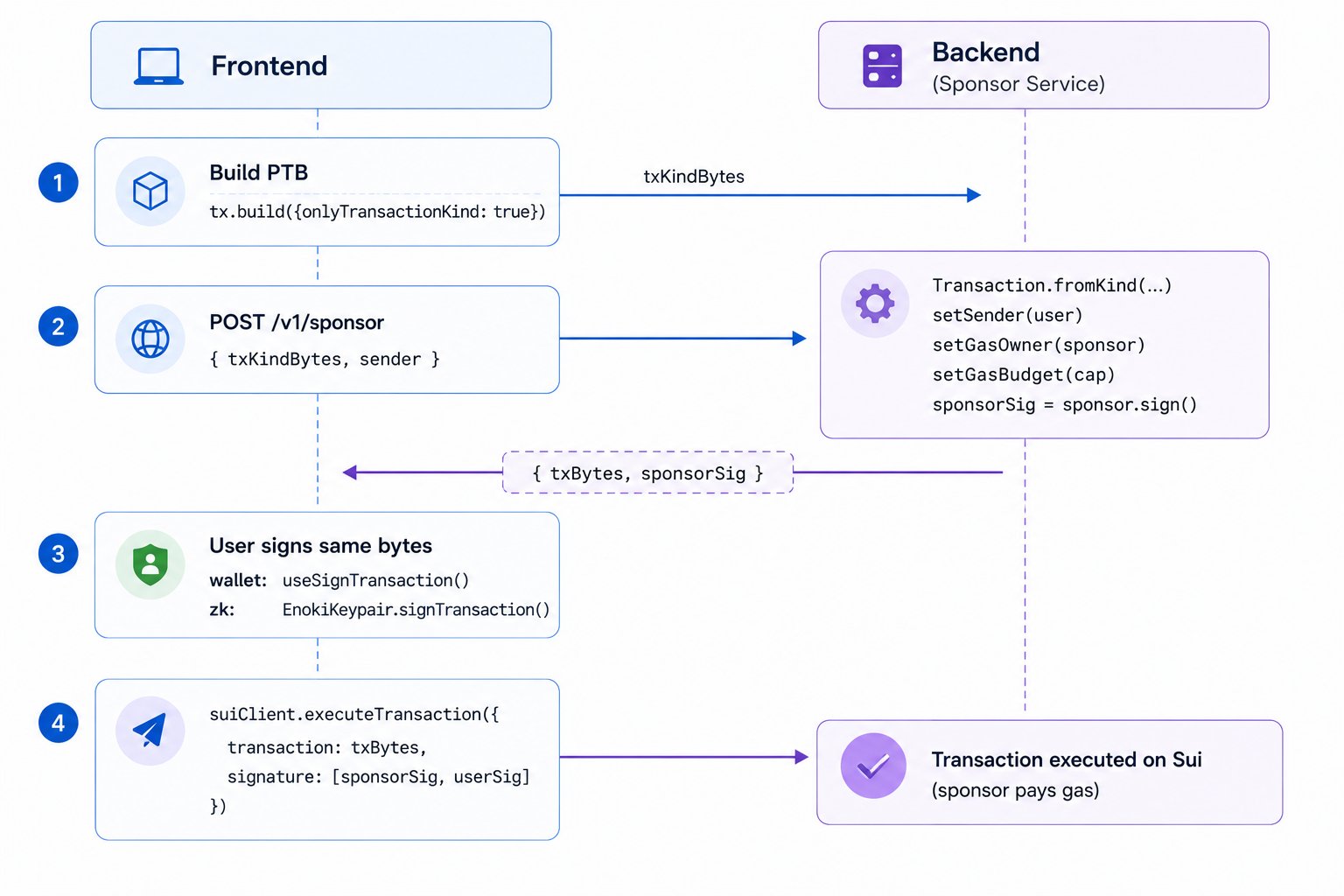 Chain enforces `sender == user` (their signature is mandatory). Gas comes from the sponsor.
## Abuse bounds
Three caps prevent a hostile PTB:
| Env var | Default | Bound |
| -------------------------------- | ------- | ------------------------------------ |
| `SPONSOR_MAX_GAS_BUDGET_SUI` | `0.03` | Per-tx hard ceiling on gas budget |
| `SPONSOR_PER_USER_DAILY_CAP_SUI` | `0.5` | Per-sender daily cap (Redis-tracked) |
| `SPONSOR_DAILY_CAP_SUI` | `5` | Global daily cap |
Redis keys `sponsor:user::` and `sponsor:global:` use `INCRBYFLOAT` with `EXPIRE`-to-end-of-day.
Worst case: one bad actor at the per-user cap drains 0.5 SUI/day, the global cap drains 5 SUI/day total. Both fit a hackathon budget.
PTB-command inspection (reject `tx.gas` references in `TransferObjects` and `SplitCoins`) is a v0.4 hardening follow-up.
## Frontend integration
`packages/frontend/src/lib/wallet.ts` is the three-strategy signer:
1. **Self-sponsor first.** Works for both wallet and zk users. Sponsors any package.
2. **Enoki sponsorship.** Zk users only, on `SponsorUnavailableError`.
3. **Direct execution.** User pays gas (last resort).
All 11 sign call sites flow through `useTxSigner()` which encapsulates the cascade.
## GET /v1/sponsor
```json theme={"system"}
{
"enabled": true,
"sponsorAddress": "0x…",
"perUserDailyCapSui": 0.5,
"globalDailyCapSui": 5,
"maxGasBudgetSui": 0.03
}
```
The UI uses this to decide whether to show the "Gas sponsored" badge.
Chain enforces `sender == user` (their signature is mandatory). Gas comes from the sponsor.
## Abuse bounds
Three caps prevent a hostile PTB:
| Env var | Default | Bound |
| -------------------------------- | ------- | ------------------------------------ |
| `SPONSOR_MAX_GAS_BUDGET_SUI` | `0.03` | Per-tx hard ceiling on gas budget |
| `SPONSOR_PER_USER_DAILY_CAP_SUI` | `0.5` | Per-sender daily cap (Redis-tracked) |
| `SPONSOR_DAILY_CAP_SUI` | `5` | Global daily cap |
Redis keys `sponsor:user::` and `sponsor:global:` use `INCRBYFLOAT` with `EXPIRE`-to-end-of-day.
Worst case: one bad actor at the per-user cap drains 0.5 SUI/day, the global cap drains 5 SUI/day total. Both fit a hackathon budget.
PTB-command inspection (reject `tx.gas` references in `TransferObjects` and `SplitCoins`) is a v0.4 hardening follow-up.
## Frontend integration
`packages/frontend/src/lib/wallet.ts` is the three-strategy signer:
1. **Self-sponsor first.** Works for both wallet and zk users. Sponsors any package.
2. **Enoki sponsorship.** Zk users only, on `SponsorUnavailableError`.
3. **Direct execution.** User pays gas (last resort).
All 11 sign call sites flow through `useTxSigner()` which encapsulates the cascade.
## GET /v1/sponsor
```json theme={"system"}
{
"enabled": true,
"sponsorAddress": "0x…",
"perUserDailyCapSui": 0.5,
"globalDailyCapSui": 5,
"maxGasBudgetSui": 0.03
}
```
The UI uses this to decide whether to show the "Gas sponsored" badge.